Deep Heat

Our current research programme will investigate how superhot fluids move at depth. The research will directly support the New Zealand Government's exploration efforts and is built on the success of its predecessor programme  “Geothermal: The next generation”

By advancing the science of fluid movement in extreme conditions, we can unlock a world-first clean energy source that strengthens energy security, accelerates decarbonisation, and positions New Zealand as a global leader.

isabelle chambefort

Programme Co-lead
Projects

We’re bringing together a diverse and cohesive team of geophysicists, geologists, geochemists, modellers and strategic advisors with a strong foundation in international collaboration.

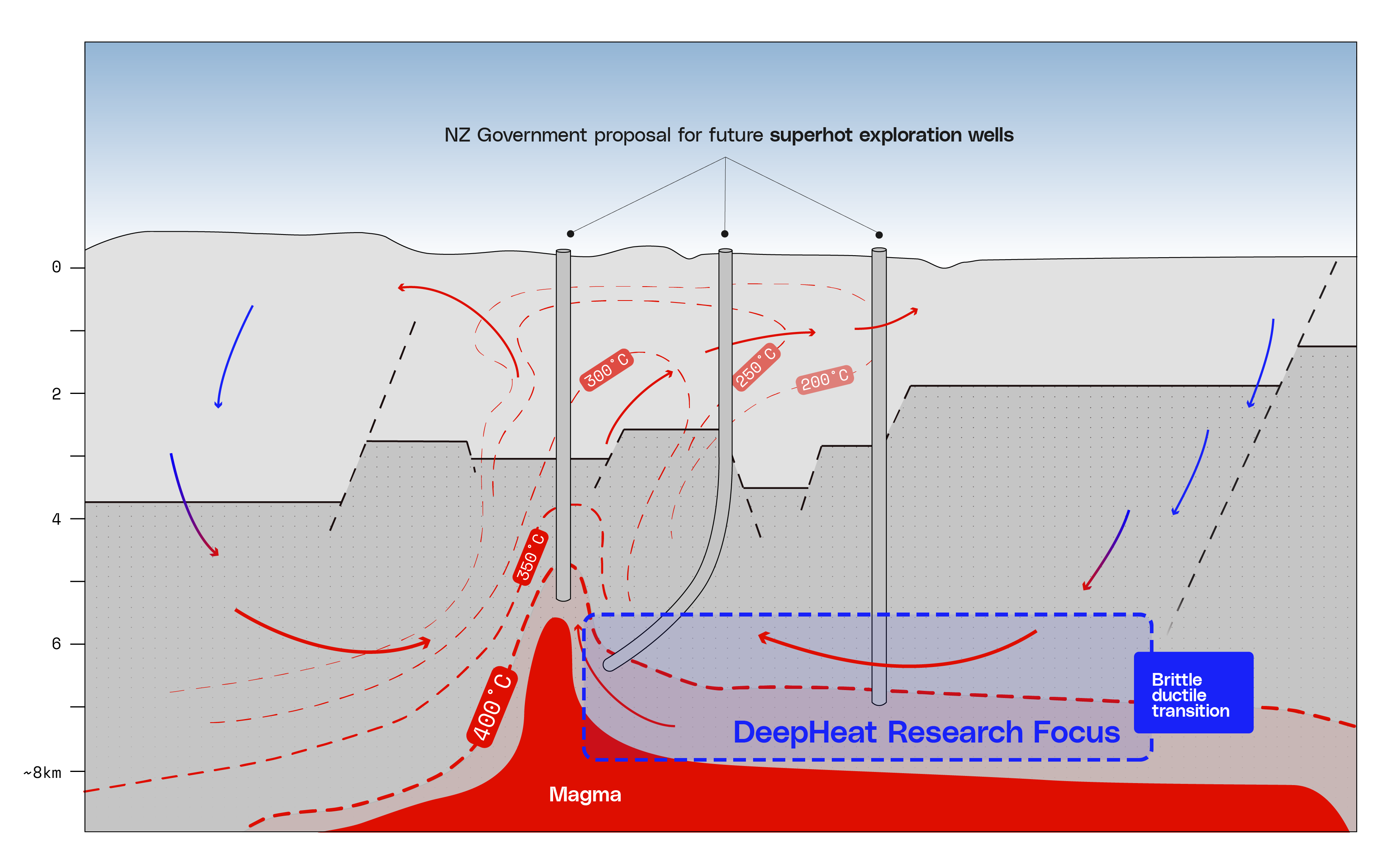
By tapping deeper into reservoir, New Zealand could unlock around 30,000 GWh of continuous renewable power each year.  Realising this potential requires is hampered by a limited understanding of fluid movement near and within the Brittle-Ductile Transition (BDT) zone. The BDT is the region between hot ductile rock near magma and cold brittle rock above and is where superhot fluids exist.

Our DeepHeat Programme will investigate how these superhot fluids move within the BDT, developing AI-driven reservoir models, conducting fracture network experiments, and assessing wellbore performance.

We will also advance stimulation and well-integration technologies, evaluate energy and economic scenarios, establish environmental monitoring frameworks, and co-design Māori-led business models to ensure long-term sustainable benefits.     
Dashboard mockup
Conceptual model of the Brittle Ductile Transition Zone, where the DeepHeat research programme is focused.

Natural behaviour of the Brittle-Ductile Transition (BDT)

goal

To characterise the natural behaviour of the BDT in the Central Taupō Volcanic Zone to inform superhot geothermal exploration and targeting.

hypothesis

Failure modes and fluid density fluctuations within the BDT primarily control permeability and flow pathways.

research question

How do the BDT’s structure, mechanics, and fluid–rock interactions govern permeability and sustained superhot fluid flow?

activities
  • Map the physical structure and properties of the BDT in three-dimensions using new high-density seismic node arrays
  • Develop cutting-edge mass flow, fracture network, and geodynamic reservoir models to overcome limitations of geophysical models in simulating the BDT
  • Experimentally characterise geomechanics and fluid flow under varying physical and chemical conditions representative of superhot geothermal samples from the CTVZ

Modelling the energy potential

goal

To build an integrated, AI‑assisted modelling framework that reliably predicts permeability evolution and guides continuous, commercially viable superhot geothermal hypothesis

hypothesis

By coupling deep fracture networks and continuum‑scale models with geophysical and geomechanical constraints, and closing the loop with real‑time data through an AI‑driven decision support system, we can accurately forecast permeability and optimise drilling, testing, and stimulation strategies for sustained superhot reservoir performance.

research question

How can we accurately forecast permeability and optimise drilling, testing, and stimulation strategies for sustained superhot reservoir performance?

activities
  • Develop a reservoir fracture network model in near real-time
  • Create a reservoir recharge model
  • Develop well-targeting and development protocols
  • Create an interactive AI-driven Decision Support System (DSS) to integrate all research components
  • Design and adapt suitable permeability enhancement and well-intervention technologies to enable continuous energy production for commercial use.

Supporting the path to commercialisation

goal

Evaluate techno‑economic feasibility and develop culturally aligned, environmentally responsible commercial pathways for superhot geothermal energy.

hypothesis

Combining refined techno‑economic analysis with Māori-led business frameworks and robust environmental modelling can accelerate the commercial deployment of superhot geothermal energy.

research question

What commercial, cultural, environmental, and techno‑economic frameworks are needed to enable superhot geothermal development?

activities
  • Conduct techno-economic feasibility study for best energy extraction practices
  • Support the development of a business model for superhot geothermal projects tailored to Māori trusts.

Meet our Research Team

Wiebke Heise
GNS Science

Wiebke is an electromagnetic geophysicist with special expertise in magnetotellurics, and application to geothermal exploration, crustal and lithospheric tectonics and volcanological processes.

In the GNG Programme, Wiebke will improve the modelling codes to better resolve magnetotelluric (MT) anomalies in the TVZ, and the integration of seismic and MT models.

Melissa Climo
Bridger Consulting

Melissa is a research manager and strategy consultant with expertise in communicating and translating research science, as well as in project design and delivery.

In the GNG Programme, Melissa will drive the supercritical strategy development, and participate in stakeholder consultation, engagement and communication.

Deborah Kissick
Traverse Environmental

Deborah is a practicing planner who has worked in consent enforcement and monitoring roles in both New Zealand and overseas. She has experience in the development of planning documents under the Resource Management Act 1991 (RMA), including development provisions, hearings and appeals, plan changes and as a reporting officer.

In the GNG Programme, Deborah will examine New Zealand’s regulatory and planning frameworks for conventional geothermal resources and their applicability for utilisation of supercritical.

Andrea Blair
Upflow

Andrea (Andy) focuses on the development and implementation of domestic and international business strategies, and the commercialization of geothermal scientific products and services. Her expertise intersects of science, business, and the community, specifically her ability to translate scientific thinking to non-science people, and provide real world context to technical specialists.  

In the GNG Programme, Andrea will communicate the research science and lead stakeholder engagement, in New Zealand and internationally.

Isabelle Chambefort
GNS Science

Isabelle’s research centres on the magmatic hydrothermal geochemical transition in hydrothermal systems in volcanic arcs. Her expertise covers the fields of igneous petrology, fluid, and gas chemistry; magmatic-hydrothermal ore deposits; magmatic volatile exsolution and chemistry; geological stratigraphy and evolution reconstruction; volcanic-hosted hydrothermal systems and water-rock mineral interaction.

In the GNG Programme, Isabelle will examine how magma in the TVZ can transport fluid and heat to geothermal systems. In her role as Programme Leader, she will manage the programme and ensure science results are delivered and communicated appropriately.

contact us

Get in Touch with the Research Team

Thank you! Your submission has been received!
Oops! Something went wrong while submitting the form.