By tapping deeper into reservoir, New Zealand could unlock around 30,000 GWh of continuous renewable power each year. Realising this potential requires is hampered by a limited understanding of fluid movement near and within the Brittle-Ductile Transition (BDT) zone. The BDT is the region between hot ductile rock near magma and cold brittle rock above and is where superhot fluids exist.
Our DeepHeat Programme will investigate how these superhot fluids move within the BDT, developing AI-driven reservoir models, conducting fracture network experiments, and assessing wellbore performance.
We will also advance stimulation and well-integration technologies, evaluate energy and economic scenarios, establish environmental monitoring frameworks, and co-design Māori-led business models to ensure long-term sustainable benefits.
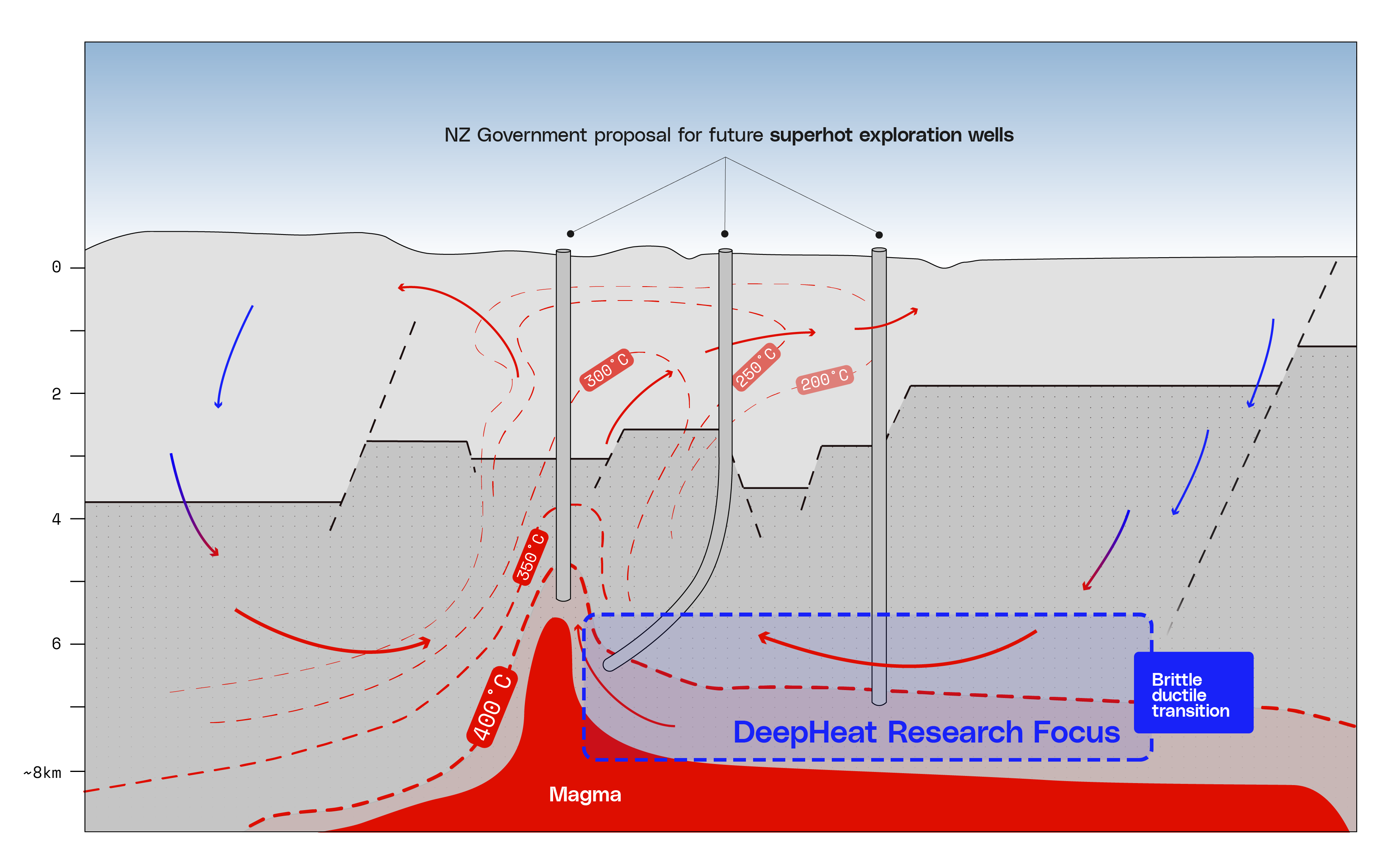
To characterise the natural behaviour of the BDT in the Central Taupō Volcanic Zone to inform superhot geothermal exploration and targeting.
Failure modes and fluid density fluctuations within the BDT primarily control permeability and flow pathways.
How do the BDT’s structure, mechanics, and fluid–rock interactions govern permeability and sustained superhot fluid flow?
To build an integrated, AI‑assisted modelling framework that reliably predicts permeability evolution and guides continuous, commercially viable superhot geothermal hypothesis
By coupling deep fracture networks and continuum‑scale models with geophysical and geomechanical constraints, and closing the loop with real‑time data through an AI‑driven decision support system, we can accurately forecast permeability and optimise drilling, testing, and stimulation strategies for sustained superhot reservoir performance.
How can we accurately forecast permeability and optimise drilling, testing, and stimulation strategies for sustained superhot reservoir performance?
Evaluate techno‑economic feasibility and develop culturally aligned, environmentally responsible commercial pathways for superhot geothermal energy.
Combining refined techno‑economic analysis with Māori-led business frameworks and robust environmental modelling can accelerate the commercial deployment of superhot geothermal energy.
What commercial, cultural, environmental, and techno‑economic frameworks are needed to enable superhot geothermal development?