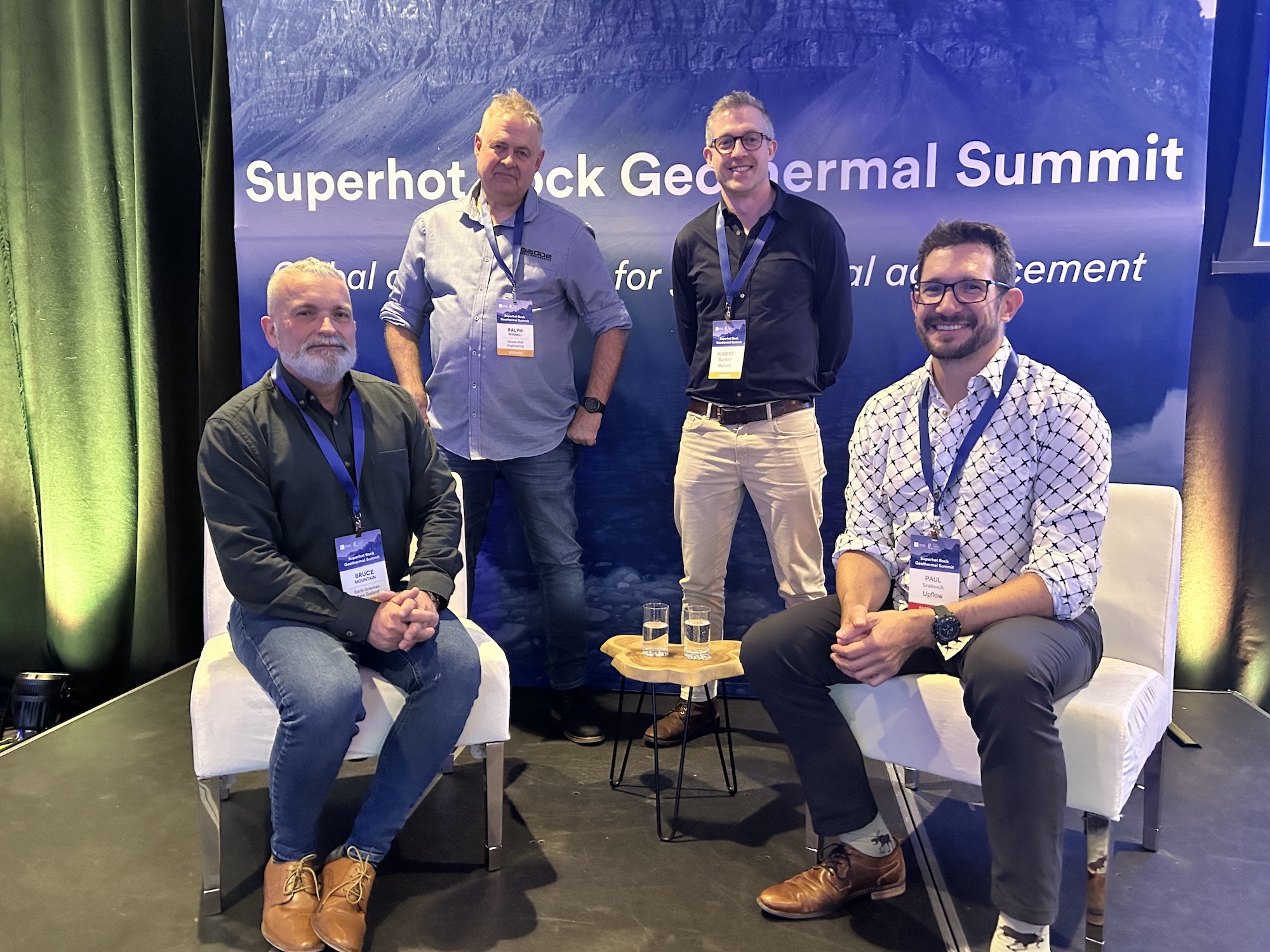
Ahead of the World Geothermal Congress, in June 2026, the Clean Air Task Force brought around 100 people to Banff (Alberta, Canada) for two and a half days on one question:
What is actually standing between us and superhot geothermal?
The room was deliberately mixed — regulators, engineers, financiers and policy people from Canada, Iceland, Italy, Japan, Indonesia, the United States and Aotearoa New Zealand. Teams from the National Institute of Advanced Industrial Science and Technology (AIST) in Japan, the Iceland Deep Drilling Project (IDDP), Mazama Energy and Quaise Energy all brought hard-won experience to the table.
New Zealand was represented through GeoSHOT NZ, with Ralph Windmill (Geode), Robert Rankin (Mercury), Bruce Mountain (Earth Sciences New Zealand) and Paul Siratovich (Upflow).
Presentations, breakout sessions, poster walls and a great many post-it notes worked through well design and completions, geochemistry and fluid handling, drilling and logging technology, surface conversion, modelling — and the standards and regulatory settings that superhot development will need.
One thing stood out: New Zealand has a mature regulation and policy landscape for conventional geothermal, much of which is adaptable to superhot conditions. In many other jurisdictions those frameworks simply don't exist yet, which makes an already difficult technical problem considerably harder. That is a genuine advantage for New Zealand, and one worth capitalising.
The most valuable outcome from the summit wasn't a slide. It was the connections — GeoSHOT NZ is now tied directly into the emerging superhot workstreams globally.
Thanks to the Clean Air Task Force for convening the summit, and to the Bezos Earth Fund for the support that made it possible.
For more on the learnings from the summit, read this summary by the Clean Air Task Force: Superhot Rock Geothermal Summit 2026: Learning together to commercialize faster